Plantalk AI
Quick Diagnosis
Note which leaves yellow first, whether whole leaves or just the areas between veins turn yellow, and whether the plant wilts.
| What you see | Likely cause | What to do |
|---|---|---|
| Lower leaves yellow; mix stays wet | Overwatering or poor drainage | Let the top 5 cm (2 in) dry; empty the saucer |
| Wilting in wet mix; brown, soft roots | Root rot | Trim rotted roots and repot, or discard if most are dead |
| Wilting, gray-green leaves; dry mix shrinking from the pot | Underwatering | Water until it drains; check more often |
| Yellowing and leaf drop in a dim spot; stretched stems | Too little light | Move to a brighter spot, avoiding sudden direct sun |
| An occasional oldest leaf yellows; new growth is healthy | Natural aging | Nothing to fix |
| Older leaves turn pale yellow first; slow growth | Nitrogen shortage | Feed with a general-purpose liquid fertilizer |
| Yellow between veins on the newest leaves (iron) or older leaves (magnesium) | Iron or magnesium shortage | Fix watering first; then add iron or magnesium |
| Yellowing or leaf drop after a cold draft, a move or repotting | Chilling or shock | Keep above 10 °C (50 °F); allow about three weeks |
| Pale speckles, fine webbing, mites under the leaves | Spider mites | Isolate; rinse the leaves; use insecticidal soap if needed |
Overwatering, Poor Drainage and Root Rot
How to tell: Older leaves yellow and may drop while the mix stays wet3,4. Algae on the surface and a soft stem base also point to excess water2,3. Wilting in wet mix suggests root rot, so check the roots2. Healthy roots are white, at least under their outer layer2. Rotted roots are brown to black and may be soft1,2.
What to do: Wait until the top 5 cm (2 in) is dry, then water until it drains and empty the saucer4. Use pots with drainage holes6. Old mix compacts and drains poorly, so repot if it stays soggy2,4. Skip a gravel layer at the bottom: it doesn't improve drainage but raises the waterlogged zone closer to the roots7.
If only a few roots have rotted, cut them out and repot in sterile mix1. If most roots are dark, soft and dead, discard the plant1. Our root rot guide has more.
Underwatering
How to tell: A dry plant wilts and turns gray-green4. If it stays dry too long, lower leaves yellow and die, and leaves may drop1. The pot feels light, and the mix may pull away from the pot's edge3,4.
What to do: Water thoroughly until it drains from the bottom, then check the mix more often4. If a plant needs water very often, or your finger can't get 5 cm (2 in) into the mix, it may be pot-bound4,6. Move it to a pot about one-third wider and deeper6.
Too Little Light
How to tell: Too little light can yellow older or newer leaves and make them drop2,3. New stems often stretch, with long gaps between leaves2.
What to do: Move the plant somewhere brighter, such as nearer a window. Avoid a sudden move into hot, direct sun, which can sunburn leaves2.
Natural Aging of Older Leaves
How to tell: Old leaves can yellow from natural aging3. That's the likely reason when only the occasional oldest leaf yellows and the rest of the plant looks healthy.
What to do: Nothing needs fixing. Just clear fallen leaves from the pot2.
Nutrient Deficiencies
How to tell: Note where the yellowing starts3,5.
- Nitrogen: Older leaves turn pale yellow first, then the yellowing spreads to younger ones5. Pot-bound plants are especially prone1.
- Magnesium: Older leaves yellow between the veins, sometimes with reddish-brown tints, then may brown and drop early3,5.
- Iron: The youngest leaves yellow between the veins3,5. Alkaline conditions make iron harder for roots to take up5.
Deficiencies are hard to tell apart, and drought, waterlogging and low light can mimic them5. Soggy mix also hinders uptake5. Rule out watering and light problems before you feed.
What to do: Nutrients in fresh potting mix last only about 6 to 8 weeks, so feed regularly with a general-purpose liquid fertilizer5. For iron, use a liquid feed with sequestered (chelated) iron5. For magnesium, the RHS suggests an Epsom salt (magnesium sulfate) leaf spray and warns that high-potassium feeds can cause the shortage5.
Too much fertilizer can also yellow young leaves and cause wilting3. White crusty deposits on the mix or pot rim mean salts are building up1. Flush the pot with clear water every four to six months4. Salts can also cause brown leaf tips2.
Cold Drafts and Sudden Temperature Changes
How to tell: Exposure to low temperatures can yellow leaves and make them drop1,2. Chilling below 10 °C (50 °F) can cause leaf spots, and cold damage can blacken leaves2,3. Sudden temperature changes can also trigger leaf drop2.
What to do: Move the plant away from cold windows, outside doors and drafts2. Keep it above 10 °C (50 °F)2.
Shock After Moving or Repotting
How to tell: Leaves yellow or drop soon after a move or repotting. Sudden changes in light, temperature or humidity can cause leaf drop2, and some yellowing after repotting is normal6.
What to do: Keep care steady. Leaf drop after a big change in surroundings should stop within about three weeks1. After repotting, give the plant indirect light for a few days and don't fertilize for at least two weeks6.
Spider Mites and Other Pests
How to tell: Spider mites leave tiny pale speckles, called stippling, and leaves later yellow, bronze and dry out2. Fine webbing may appear near growing tips2. The mites are about 0.5 mm (0.02 in) long and live mostly under the leaves, so use a 10x hand lens2. Dry, dusty indoor conditions favor them2. Whiteflies, mealybugs, scale and thrips can also yellow leaves2.
What to do: Isolate the plant2. Wash the leaves often with water, including the undersides, and reduce dust2. If mites persist, use an insecticidal soap or horticultural oil labeled for indoor use on that plant2. Mites grow from egg to adult in about two weeks at 24 °C (75 °F), so keep checking2. Misting won't fix dry air: it raises humidity for only about 20 minutes. A humidifier works better7.
How to Prevent Yellow Leaves
- Water when the top 5 cm (2 in) is dry, not on a schedule; succulents and cacti need far less4.
- Use pots with drainage holes, empty saucers and skip the gravel layer4,6,7.
- Feed regularly, following the label, and flush the mix with clear water every four to six months4,5.
- Choose plants that suit your light and temperature, and keep them out of drafts2.
- Check new plants for pests weekly for several weeks, then monthly2.
- Read up on your plant's needs in our monstera, pothos, snake plant, fiddle leaf fig and peace lily guides.
When to Get Help
Ask for help if yellowing keeps spreading after you fix watering, light and temperature, or if you can't identify a pest2. Soft, mushy stems with a bad smell can mean a bacterial disease, which is hard to control2. Take photos or a sample to a local nursery, plant clinic or, in the US, a county Cooperative Extension office2. Sometimes starting over with a new plant is the better choice1,2.
How Plantalk AI Helps
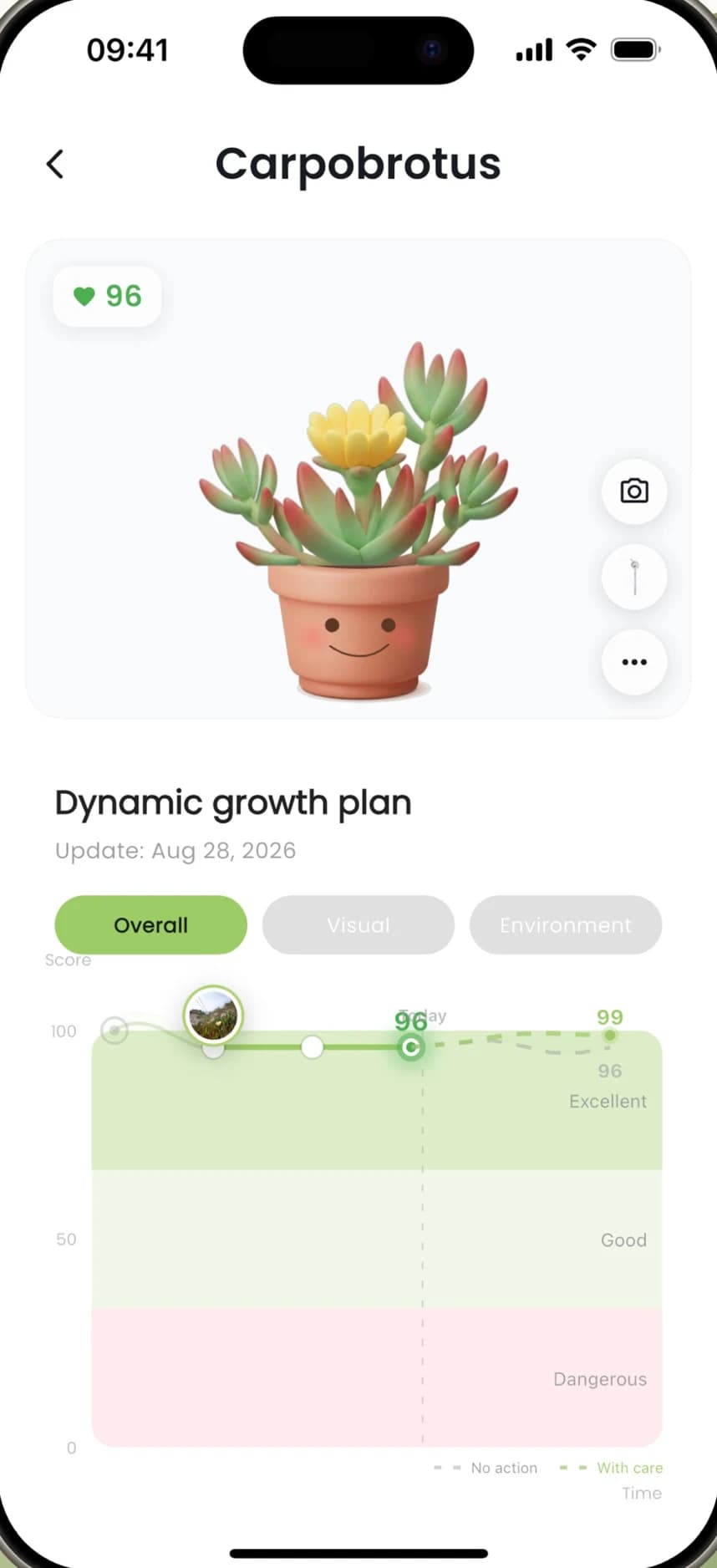
In Plantalk AI, you can send the Plantie Assistant a photo of a yellow leaf for step-by-step answers. Photo identification gives each plant a profile with its ideal light and temperature ranges, and Plant Health tracks its health score. The Plantiemoji sensor, sold separately, shows live soil moisture, light and temperature readings. The app's answers are guidance, so for serious pest or disease problems, also ask a local nursery or plant clinic.
Common Questions
How Do I Tell Overwatering From Underwatering?
Feel the mix 5 cm (2 in) down and lift the pot4. Wet mix, a heavy pot or surface algae point to overwatering3,4. Dry mix pulling from the pot's edge, a light pot and gray-green wilting point to underwatering3,4. Both can make leaves yellow and drop1.
Why Are the Lower Leaves Turning Yellow?
Causes include overwatering, root rot, a pot-bound plant, nitrogen or magnesium shortage and natural aging3. If only an occasional old leaf yellows and new growth looks healthy, it's probably aging. If several yellow at once, check drainage and roots first1.
Why Are New Leaves Turning Yellow?
Yellow new leaves can point to low light, iron shortage or too much fertilizer3. Overwatering and a pH imbalance in the mix are other causes2.
What Do Yellow Leaves With Green Veins Mean?
Yellow between green veins is a typical sign of a nutrient shortage5. On the newest leaves it suggests iron, and on older leaves magnesium3,5. Fix watering first, because waterlogged mix can cause similar signs5.
Sources
- Houseplant Diseases & Disorders, Clemson Cooperative Extension Home & Garden Information Center
- Pest Notes: Houseplant Problems, University of California Statewide Integrated Pest Management Program
- Diagnosing Poor Plant Health, Penn State Extension
- Watering Indoor Plants, University of Maryland Extension
- Nutrient deficiencies, Royal Horticultural Society
- Ask Steward: How do I repot a houseplant?, Montana State University Extension
- Gardening Advice: Fact or Fiction, University of Missouri Integrated Pest Management
About this guide. Drafted by the Plantalk AI team with AI assistance, checked against the sources listed on each page, and reviewed by an expert before publishing. Reviewed by Bingqing Qi, Wageningen University & Research, on November 9, 2026. Spotted something that needs fixing? Tell us.