Plantalk AI
Monstera deliciosa, also called Swiss cheese plant or split-leaf philodendron, is a climbing evergreen vine in the arum family, Araceae1. It grows wild in rainforests from southern Mexico to Panama, where it climbs trees with long aerial roots2. Indoors it often reaches 1.8 to 2.4 m (6 to 8 ft)1.
At a Glance
| Need | What it likes |
|---|---|
| Botanical name | Monstera deliciosa (family Araceae) |
| Light | Bright, indirect light; no strong midday sun |
| Water | When the top 2.5–5 cm (1–2 in) of mix is dry; less in winter |
| Temperature | 18–25°C (65–77°F); growth stops below 10°C (50°F) |
| Humidity | Medium to high, ideally above 50% |
| Soil | Open, well-draining mix; pot with a drainage hole |
| Feeding | Balanced liquid fertilizer every 2–4 weeks, April to September |
| Pet safety | Toxic to cats and dogs (ASPCA) |
Light
Monstera grows best in bright, indirect light, such as near an east- or west-facing window3. That light casts a clear shadow, but no sun falls on the leaves5. Spots more than about 1 m (a few feet) from a bright window are often too dim5. Strong midday sun can scorch the leaves3,4. In winter, when light is weaker, a brighter spot such as a south-facing window helps2,4. In low light, stems get leggy and new leaves have fewer holes or none1–3.
Watering
Water thoroughly, until water runs out of the drainage hole5. Then let the top 2.5 to 5 cm (1 to 2 in) of mix dry before you water again1. Test the mix with a finger rather than following a calendar5. If it still feels damp, check again in a day or two5.
Empty the saucer after 30 to 45 minutes, and never leave the pot standing in water3,5. Water less often in winter, when every two weeks or so may be enough3,4. Use rainwater or filtered water at room temperature where you can, especially in hard-water areas3.
Temperature and Humidity
Keep your monstera at 18 to 25°C (65 to 77°F) all year, away from cold drafts and radiators3. Growth stops below 10°C (50°F), and frost kills the plant2.
It likes medium to high humidity, preferably above 50%1,2. A humidifier is very effective5. Grouping plants also helps, as does a tray of wet pebbles with the pot sitting above the water4,5. Misting is a popular tip, but it raises humidity for only a few minutes and can help spread disease5.
Soil, Pots and Repotting
Use an open, well-draining mix1,3. The RHS suggests 1 part peat-free ericaceous (lime-free) mix to 2 parts orchid mix3. Penn State Extension suggests adding bark, perlite or charcoal to a bagged mix1.
Always use a pot with a drainage hole5. Skip the gravel layer in the bottom: it keeps the mix above it wetter and promotes root rot5. For a decorative pot without a hole, set a draining pot inside it5.
Repot every few years, when the plant gets top-heavy, growth slows or the mix dries out very fast3,5. Choose a heavy pot only a few centimeters (an inch or two) larger than the old one, since oversized pots stay wet too long3. Late winter or early spring is best5.
Feeding
Feed only while the plant is actively growing, which the RHS puts at April to September3,5. Use a balanced liquid houseplant fertilizer every 2 to 4 weeks1,5. Mix a general all-purpose fertilizer at half or quarter strength5. Feed less or stop in winter, and wait 2 to 4 weeks after repotting1,3,5.
Support, Leaf Splits and Aerial Roots
Monstera is a climber, and its heavy stems need support so they don't break2. A moss pole is the usual choice; trellises, stakes and moss-covered boards also work1,3. Sink the support into the pot and tie the stem to it gently1,2. Keep the moss moist, so the aerial roots can root into it and take up water2,3.
Young plants make small, uncut leaves. The holes and splits, called fenestrations, usually appear once a plant is a few years old1,3. In very low light, leaves have fewer holes or none2,3. A climbing plant often makes larger, more mature leaves with more holes3.
Aerial roots are normal. They grow from the stem and anchor the plant as it climbs2,3. Guide them onto the moss pole or into the pot, since roots that reach the soil can root into it2,3.
Common Problems
- No holes or splits in new leaves. Likely cause: a young plant, low light or nothing to climb2,3. Fix: brighter indirect light, a moss pole and time3.
- Yellow leaves. Likely cause: one lower leaf yellowing now and then is normal on a mature plant4. Many yellow leaves point to too much or too little water, an oversized pot, low light, cold or drafts4. Fix: check the roots and mix, then adjust watering, pot size or position4. See yellow leaves.
- Brown, dry leaf edges or tips. Likely cause: dry air, or watering problems, more often too little water than too much2,4. Fix: check the roots, adjust watering and add a humidifier4,5. See brown leaf tips.
- Wilting in wet mix, with dark, soft roots. Likely cause: root rot from overwatering or poor drainage3,4. Fix: water less, trim limp or brown roots, and repot into a smaller, draining pot if roots don't fill the old one4,5. See root rot.
- Droplets on leaf edges in the morning. Likely cause: guttation, often a sign of overwatering2,4. Fix: let the mix dry a little more between waterings2.
- Sticky leaves or small insects. Likely cause: mealybugs, scale insects, aphids, spider mites or thrips1–3. Fix: wipe the leaves regularly, and for heavy infestations ask a local nursery or plant clinic3.
Propagation
Stem cuttings and air layering are the easiest methods1. Take cuttings from spring to late summer3. Cut the stem tip just below an aerial root2. Pot it up, or root it first in a glass of water in a bright spot2,3. Wear gloves, because the sap can irritate skin1,3.
How Plantalk AI Helps
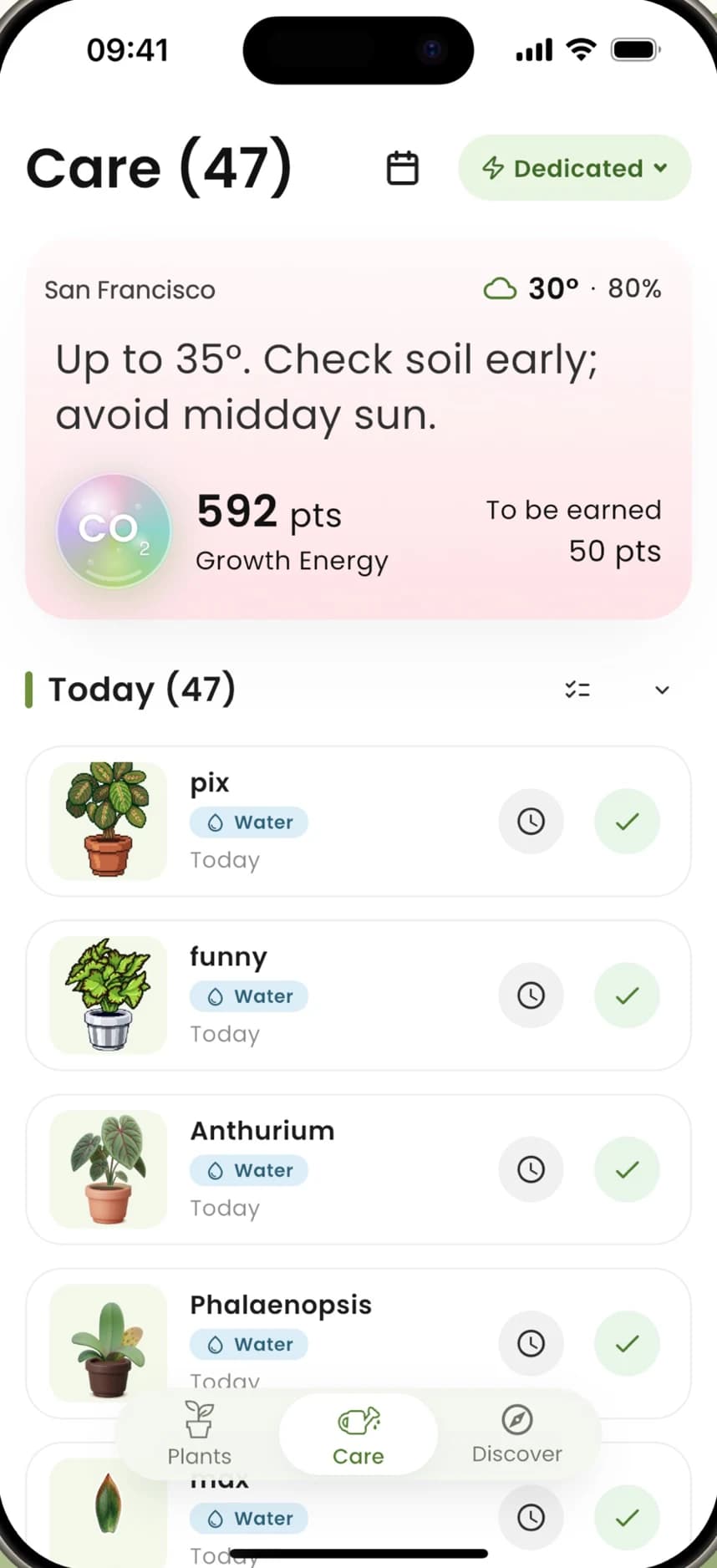
To identify your plant in Plantalk AI, tap + on the Plants screen, take or choose a photo and confirm the match. Its profile shows care tasks, ideal light and temperature ranges and a health score, and the Care screen lists what to water each day. If a leaf yellows, send Plantie a photo for step-by-step guidance; for serious pests or disease, also ask a local nursery or plant clinic. The Plantiemoji sensor, sold separately, shows live light, temperature, humidity and soil moisture readings, plus daily light integral, in the plant's Environment view.
Common Questions
How Often Should I Water a Monstera?
There is no fixed schedule5. Check the mix at least once a week, and water thoroughly when the top 2.5 to 5 cm (1 to 2 in) is dry1,4. In winter, water less often3.
Why Are My Monstera Leaves Not Splitting?
Young plants make uncut leaves, and holes usually appear after a few years1,3. Low light means fewer holes or none2,3. A moss pole helps, because a climbing plant often makes larger leaves with more holes3.
What Should I Do With Monstera Aerial Roots?
They are normal and help the plant climb2,3. Guide them onto a moist moss pole or into the pot, where they can root and take up water2,3.
Is Monstera Toxic to Cats?
Yes: the ASPCA lists it as toxic to cats and dogs because it contains insoluble calcium oxalates6. Chewing it can cause intense mouth irritation, drooling, vomiting and trouble swallowing6. Keep it out of reach, and call your vet if a pet chews it3,6. In the US, ASPCA Poison Control is at (888) 426-4435; a fee may apply6.
Sources
- Monstera as a Houseplant, Penn State Extension
- Swiss-Cheese Plant, Monstera deliciosa, Wisconsin Horticulture, University of Wisconsin–Madison Division of Extension
- How to grow Swiss cheese plants, Royal Horticultural Society
- Leaf damage on houseplants, Royal Horticultural Society
- How to Care for Houseplants, Iowa State University Extension and Outreach
- Cutleaf Philodendron, ASPCA
About this guide. Drafted by the Plantalk AI team with AI assistance, checked against the sources listed on each page, and reviewed by an expert before publishing. Reviewed by Bingqing Qi, Wageningen University & Research, on November 9, 2026. Spotted something that needs fixing? Tell us.