Plantalk AI
Quick Diagnosis
| What you see | Likely cause | What to do |
|---|---|---|
| Tips and edges brown, worse in winter | Low humidity | Run a humidifier; move plants away from heaters |
| Browning after the mix dried out | Dry soil or uneven watering | Water thoroughly; check the mix first next time |
| White crust on the soil or pot rim | Salt build-up | Scrape off crust; flush with twice the pot's volume of water |
| Wet soil; brown, soft or smelly roots | Overwatering and root rot | Let the mix dry; trim rotten roots and repot |
| Roots fill or circle the pot | Root-bound plant | Move to a larger pot; loosen the roots |
| Slow tip burn on spider plant, dracaena or calathea | Fluoride or other chemicals in tap water | Switch to rainwater or filtered water |
| Sunburn-like patches after a move into sun | Too much direct sun or heat | Move out of direct sun; adjust light gradually |
| Browned or blackened growth after cold or drafts | Cold damage | Keep plants 15 cm (6 in) from cold glass and outside doors |
Low Humidity
Iowa State Extension calls low humidity the most common reason for brown leaf tips, and indoor air is often driest in winter2. Many houseplants grow well at 40 to 60 percent relative humidity1. NC State Extension puts the average in heated or air-conditioned homes at 10 to 15 percent1.
How to tell: Tips die and edges brown, sometimes with yellowing or curling1. Cacti, succulents and bromeliads cope with dry air, so check other causes for them1.
What to do: A humidifier near the plants works best; keep humidity below about 60 percent to avoid mold1. Grouping plants and pebble trays also help; keep the water below the pebble tops so the pot never sits in it1. Move plants away from radiators and heat vents, which dry the air26. Skip the spray bottle: misting raises humidity for only a short time1.
Dry Soil and Uneven Watering
Letting the mix dry out too long between waterings browns tips and edges25.
How to tell: The mix is dry 5 cm (2 in) down, and the pot feels light3. Water may run down the inside of the pot without soaking in2.
What to do: Water by need, not on a schedule3. Water until it drains from the bottom so the whole root ball is wet, then empty the saucer23. Soak a bone-dry root ball in water1. Cacti and succulents need far less water3. Our monstera, pothos, snake plant, fiddle leaf fig and peace lily guides cover each plant's needs.
Salt Build-Up in the Soil
Fertilizer salts and hard-water minerals stay behind as water evaporates from the mix35. Avoid softened water, which carries more dissolved minerals than other water3.
How to tell: A white to gray crust forms on the soil, the pot rim or the outside of clay pots35. Tips brown, lower leaves may drop and growth slows3.
What to do: Leach the mix every four to six months3:
- Scrape off any salt crust.
- Pour at least twice the pot's volume of water through, and let it drain completely. A 2-liter (2-quart) pot needs at least 4 liters (about 1 gallon).
- Leach before you fertilize, not after.
- Repot if salts seem high or the pot drains poorly.
Don't let the pot sit in the drained water, or salts can soak back in1. Fertilize less, and use rainwater where you can25.
Root Damage: Overwatering, Rot and Crowded Roots
Roots that rot or run out of room can't supply enough water, so leaves brown as if dry24.
How to tell: Slide the plant out of its pot. Rotting roots are brown and soft and may smell; an underwatered plant's roots are white1. Wet soil starves roots of oxygen; watering too often, no drainage hole or a full saucer are common reasons25. In a root-bound plant, roots fill or circle the pot, and water runs straight through4.
What to do: For rot, let the mix dry, trim off brown roots and repot in fresh mix in a pot with drainage holes12. Badly rotted plants may not recover; see our root rot guide1. Overwatering often shows as yellow leaves too5. Move a root-bound plant to a larger pot, loosening the root mass by hand or cutting some away4.
Fluoride and Water Quality
Iowa State Extension says chlorine, fluoride and other water chemicals can brown tips over time on sensitive plants2. It names spider plant, ti plant, dracaena, prayer plant and calathea2. The RHS links fluoride in tap water to brown spider plant tips6.
How to tell: Suspect your water when one of these plants keeps browning slowly after humidity and watering are fixed2.
What to do: Use rainwater, filtered water or distilled water for sensitive plants36. NC State notes that perlite contains some fluoride, so leave it out of their potting mix1. Letting tap water stand for a day lets chlorine escape3. For fluoride, Iowa State and the RHS advise changing the water instead26.
Too Much Sun or Heat
Most houseplants come from shady understory habitats and can scorch in strong light2. Sun through a window can overheat leaves even when the room feels comfortable1. Hot, dry air from radiators, vents and appliances also browns tips and edges15.
How to tell: Scorch looks like sunburn2. It often follows a quick move to brighter light, such as outdoors2.
What to do: Move the plant out of direct sun2. Shift plants to brighter spots gradually, over several weeks2. Keep them away from heaters and warm appliances, and don't aim fans at them1. Scorch damage is permanent; trim it if you like2.
Cold Damage
NC State Extension says many tropical houseplants suffer chilling injury below about 10 to 13 °C (50 to 55 °F)1. Most grow best near 21 °C (70 °F) by day and 16 °C (60 °F) at night1.
How to tell: Browned, blackened or wilted growth after a cold trip, a cold window or a draft points to cold12. Damage can take weeks to appear1.
What to do: Move plants about 15 cm (6 in) back from cold windows and away from outside doors12. Don't trap them behind curtains at night2. In cold weather, wrap plants for even short trips and carry them in the heated car12. A minimum/maximum thermometer shows how cold a windowsill gets1.
Should You Trim Brown Tips?
Yes. Trimming is fine, but it is cosmetic: new browning will appear unless you fix the cause26.
- If less than a third of a leaf is brown, snip off the dead tip with scissors but leave a thin brown edge12. NC State says this keeps the leaf from dying back further1.
- Remove mostly brown leaves at the base16.
- Calatheas need no other pruning, but you can snip off faded brown leaves7.
How to Prevent Brown Tips
- Check the mix 5 cm (2 in) down, water by need, and empty saucers3.
- In winter, run a humidifier; 40 to 60 percent suits many houseplants12.
- Keep plants away from heaters, outside doors and cold glass12.
- Don't over-fertilize, and leach the mix every four to six months35.
- Give fluoride-sensitive plants rainwater or filtered water26.
- Repot when roots fill the pot4.
- Check for pests: insect feeding also browns tips, and fine webbing can mean spider mites57.
How Plantalk AI Helps
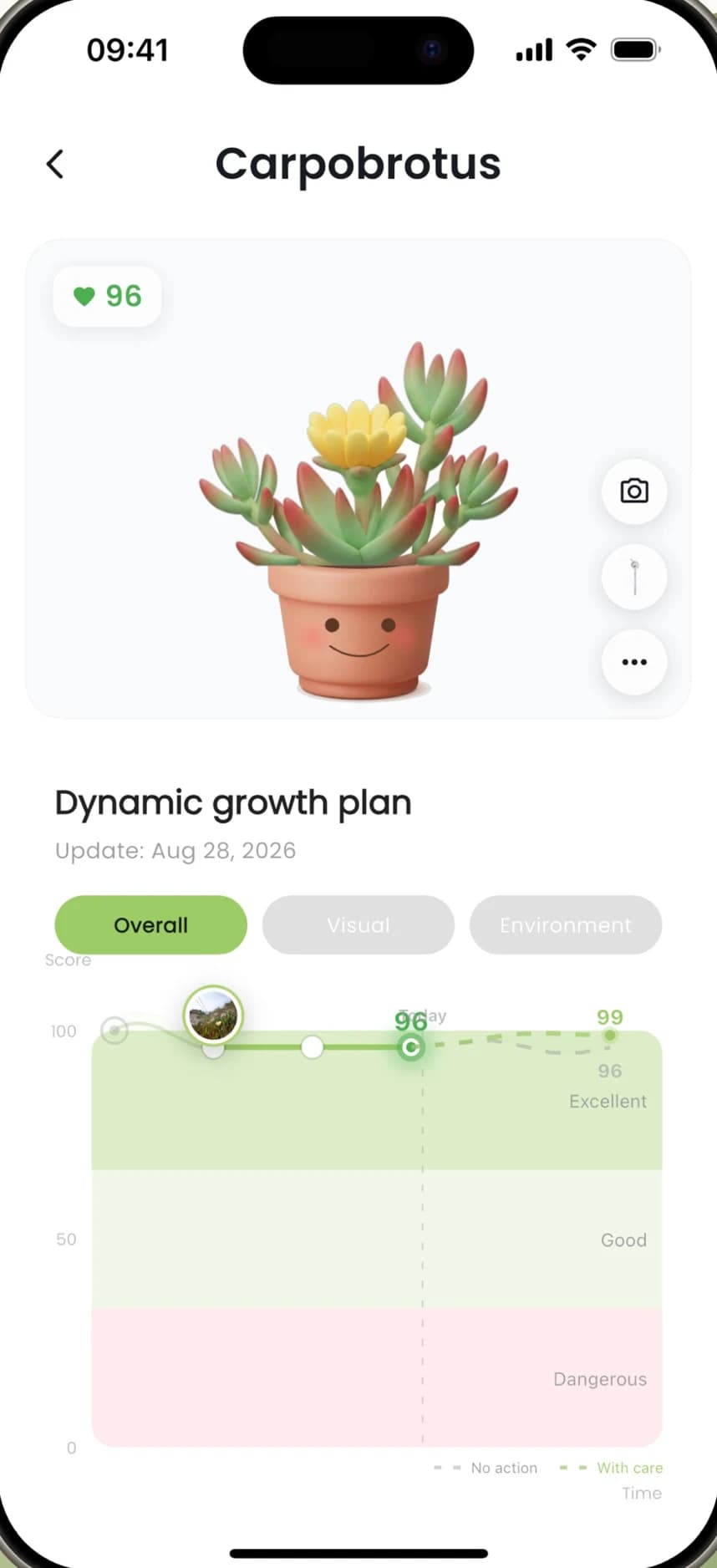
In Plantalk AI, you can send the Plantie Assistant a photo of a brown tip and get step-by-step answers. Each plant gets a care schedule, and with location on, tips adjust for local heat and humidity. The Plantiemoji sensor, sold separately, shows live humidity and soil moisture, plus VPD, a measure of how fast the air dries a plant out. The app's answers are guidance, so for serious pest or disease problems, also ask a local nursery or plant clinic.
Common Questions
Why Does My Calathea Have Crispy Edges?
The RHS says brown tips and edges on calatheas usually come from low humidity7. Keep them at 16 to 21 °C (61 to 70 °F), out of direct sun and away from drafts and radiators7. Keep the mix evenly moist in spring and summer7. Iowa State also lists calathea as sensitive to tap-water chemicals, so try rainwater2.
Why Does My Spider Plant Get Brown Tips?
The RHS names too much or too little water, fluoride in tap water, bright sun and very dry air6. It suggests rainwater or filtered water and mix that stays lightly moist6. Leave perlite out of the potting mix, since it contains some fluoride1. A badly browned plant can be cut back to 5 to 8 cm (2 to 3 in) to regrow6.
Does Misting Stop Brown Tips?
Not reliably. NC State Extension says misting raises humidity for only a short time and is a major cause of bacterial leaf diseases1. A humidifier near your plants works better1.
Sources
- 18. Plants Grown in Containers, NC State Extension (North Carolina Extension Gardener Handbook)
- Diagnosing Houseplant Problems from Improper Environmental Conditions, Iowa State University Extension and Outreach
- Watering Indoor Plants, University of Maryland Extension
- Pot-Bound Indoor Plants, University of Maryland Extension
- Houseplant Diseases & Disorders, Clemson Cooperative Extension, Home & Garden Information Center
- How to grow spider plants, Royal Horticultural Society
- How to grow calatheas, Royal Horticultural Society
About this guide. Drafted by the Plantalk AI team with AI assistance, checked against the sources listed on each page, and reviewed by an expert before publishing. Reviewed by Bingqing Qi, Wageningen University & Research, on November 9, 2026. Spotted something that needs fixing? Tell us.