Plantalk AI
Despite its name, the peace lily is not a true lily but a member of the arum family (Araceae), like anthuriums3. Its white "flower" is a spathe, a leaf-like hood around a spike of tiny true flowers1,2. Wild species grow on humid tropical forest floors in Central and South America and Southeast Asia1,2. Many houseplants are hybrid cultivars3.
At a Glance
| Need | What it likes |
|---|---|
| Botanical name | Spathiphyllum hybrids and cultivars, listed as Spathiphyllum (group); family Araceae |
| Light | Bright, indirect; no direct sun; tolerates low light |
| Water | When the top 2.5 cm (1 in) is dry; never standing in water |
| Temperature | 20–29°C (68–85°F) by day, about 6°C (10°F) cooler at night; above 16°C (60°F) |
| Humidity | 40–50% for most tropical houseplants; misting does not help |
| Soil | Well-drained potting mix; drainage hole; no gravel layer |
| Feeding | Quarter-strength balanced fertilizer every 6–8 weeks, spring and summer |
| Pet safety | Toxic if chewed but rarely serious; true lilies are far worse for cats |
Light
Peace lilies tolerate low light and even heavy shade, but grow best in bright, indirect light1,3. Bright, indirect light casts a clear shadow, but no sun rays reach the leaves4. Direct sun scorches the foliage3. UF/IFAS recommends 1,500 to 2,500 foot-candles (about 16,000 to 27,000 lux) for greenhouse growing; more bleaches the leaves2. Light fades fast away from a window, and dim spots mean slow growth and few flowers3,4.
Watering
Keep the mix moist but not soggy, letting it dry slightly between waterings3. Check it rather than watering on a fixed day, since needs change with light, warmth and season4. When it feels dry about 2.5 cm (1 in) down, water until it drains, and empty the saucer after 30 to 45 minutes4. In rooms above 27°C (80°F), keep the mix moist2.
A droop in dry mix is a clear thirst signal. Even a full collapse, which growers call a "crash," reverses within hours of a thorough watering2. Don't wait for the droop, though: Missouri Botanical Garden advises against letting the plant wilt1. A severe wilt can leave yellow or dead patches, and frequent drooping leads to brown tips and edges2.
Drinkable tap water suits most houseplants, though heavily softened water can build up salts4. Missouri Botanical Garden suggests room-temperature water left to stand so chlorine can evaporate1.
Temperature and Humidity
Peace lilies prefer 20 to 29°C (68 to 85°F) by day, with nights about 6°C (10°F) cooler1,3. Keep them above 16°C (60°F) to avoid cold damage, and away from heating and air-conditioning vents3.
Most tropical houseplants do best at 40 to 50 percent humidity, but homes can drop to 10 percent in winter4. Dry air can brown leaf tips and edges4. Misting raises humidity for only a few minutes and can spread disease4. A humidifier is very effective, and grouping plants or a pebble tray also helps; keep the pot above the tray's water4.
Soil, Pots and Repotting
Almost any well-drained potting mix works3. Use a pot with a drainage hole. A gravel layer does not replace the hole, and it creates a wetter zone that promotes root rot4.
Peace lilies like to be slightly pot-bound1,3. Repot when roots grow out of the drainage holes or circle the surface, ideally in late winter or early spring3,4. Choose a pot only 2.5 to 5 cm (1 to 2 in) larger, since an oversized pot stays too wet3.
Feeding
Peace lilies need very little fertilizer1,3. In spring and summer, feed every 6 to 8 weeks with a balanced liquid fertilizer (such as 20-20-20) at quarter strength3. Feed little or none in fall and winter, or for 2 to 4 weeks after repotting3,4. Overfeeding burns leaf tips and roots; if it happens, flush the mix with plenty of water1,2,3.
Getting It to Flower
Most cultivars bloom only between January and August2. Clemson says lack of flowering usually means a plant under a year old or too little light3. UF/IFAS adds that plants grown for 9 to 15 months usually bloom from February to April2.
Growers widely spray gibberellic acid, a plant growth regulator, to bring plants into bloom year-round2. So a plant bought in bloom may not flower again until it matures and its season comes. Treated plants generally have smaller flowers, and growth regulators may not be legal everywhere2.
If a mature plant won't bloom, move it closer to a window, out of direct sun3,4. Each bloom lasts about a month indoors; trim spent ones promptly2.
Common Problems
- Droops, mix dry: thirst. Water until it drains, and it should revive within hours2.
- Droops, mix wet: waterlogged roots, which may be sparse with black tips2. Water less often and use a mix with more air space2. See root rot.
- Droops on hot, bright afternoons, mix moist: normal above 27 to 29°C (80 to 85°F), though frequent drooping browns the tips2.
- Brown tips or edges: overfeeding, too much drying, dry air, cold or strong light2,3,4. Flush the mix, feed less and water before it wilts. See brown leaf tips.
- Black patches spreading in from leaf tips: chilling injury from drafts or long spells below 7°C (45°F)2. Move it somewhere warmer.
- Pale, bleached or curled leaves, few flowers: too much light or heat2. Move it out of direct sun and below 32°C (90°F)2.
- Yellow leaves: too much drying, a severe wilt or cold winter mix2,3. Yellow between green veins can mean magnesium deficiency3. See yellow leaves.
- Insects: fungus gnats, mealybugs, spider mites or scale3. Wipe leaves with a damp cloth, and ask a local nursery or plant clinic about heavy infestations2,3.
Dividing and Propagation
Divide a crowded peace lily when you repot2,4. Gently loosen the roots and remove dead ones3,4. Separate side shoots, each with its own roots, and pot them in fresh mix2. Water well, then wait 2 to 4 weeks before feeding4.
How Plantalk AI Helps
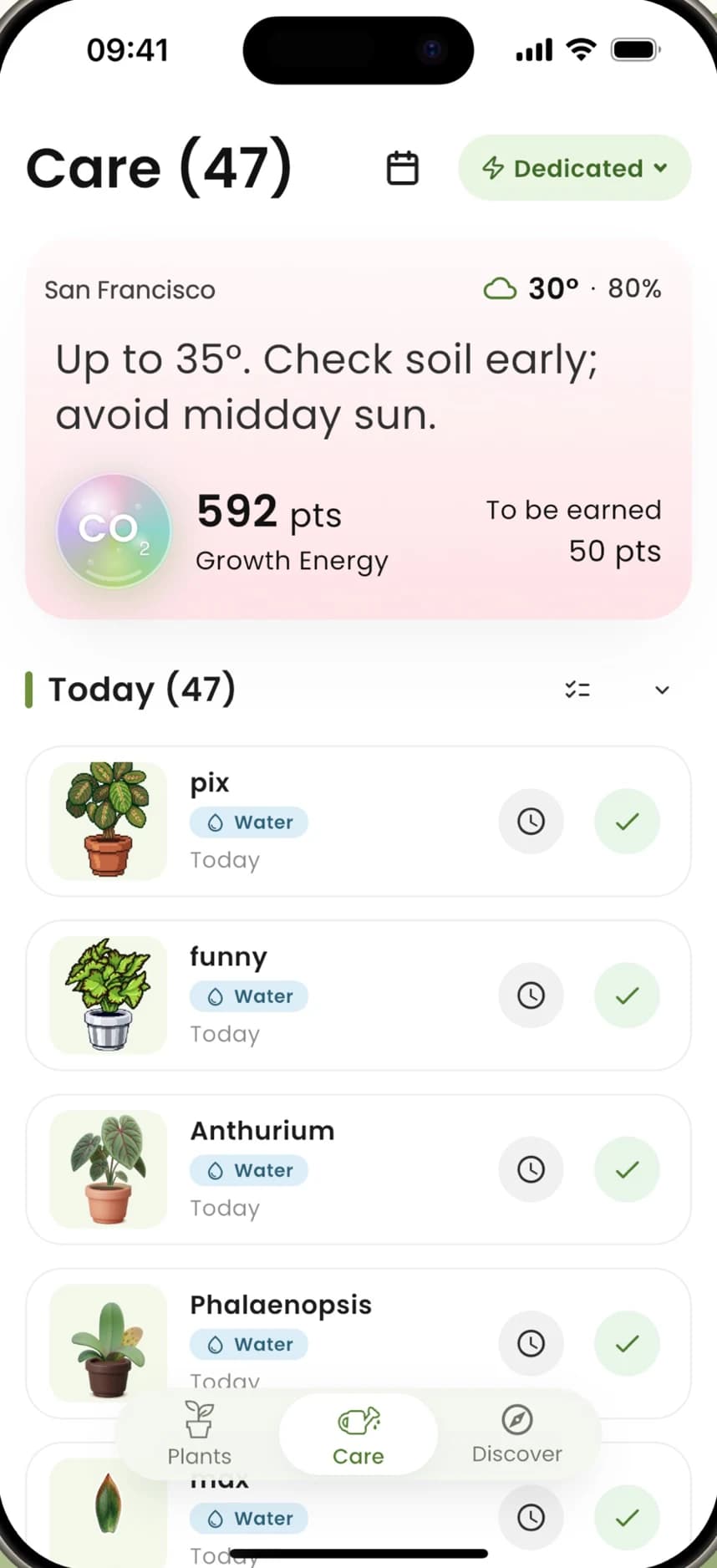
With photo identification, your peace lily gets a profile with care tasks and its ideal light and temperature ranges. The Care screen lists what to water and check each day, and you can send Plantie a photo of a symptom for step-by-step answers. The Plantiemoji sensor, sold separately, shows live soil moisture, light, temperature and humidity. The app's answers are guidance; for serious pest or disease problems, also ask a local nursery or plant clinic.
Common Questions
Is a Peace Lily Toxic to Cats?
Yes, but usually mildly: the ASPCA says chewing releases insoluble calcium oxalate crystals that can cause mouth pain, drooling, vomiting or diarrhea6. Far more dangerous are true lilies (Lilium) and daylilies (Hemerocallis): even small amounts can cause severe kidney injury in cats6. With those, treatment delayed past 18 hours is often fatal; call your vet or, in the US, ASPCA Poison Control at (888) 426-44356.
Why Is My Peace Lily Drooping?
Usually it is thirsty, and a thorough watering revives it within hours; if the mix is wet, the roots may be waterlogged instead2. Avoid repeated wilting, which yellows or browns the leaf edges2,3.
Can a Peace Lily Live in Low Light?
Yes, it tolerates low light and even heavy shade1,3. It grows best in bright, indirect light, though, and too little light often stops flowering3.
Does a Peace Lily Clean the Air?
Not measurably in a home. NASA's 1989 study found plants removed chemicals in small sealed chambers, but homes constantly exchange air and gain new pollutants5. Iowa State says even one plant per square foot (about 11 per square meter) cannot clear these chemicals effectively5.
Sources
- Spathiphyllum (group), Missouri Botanical Garden Plant Finder
- Cultural Guidelines for Commercial Production of Interiorscape Spathiphyllum (ENH958/EP161), UF/IFAS Extension
- Peace Lily (HGIC 1512), Clemson Cooperative Extension, Home & Garden Information Center
- How to Care for Houseplants, Iowa State University Extension and Outreach
- Improving Indoor Air Quality with Houseplants, Iowa State University Extension and Outreach
- Which Lilies Are Toxic to Pets?, ASPCA
About this guide. Drafted by the Plantalk AI team with AI assistance, checked against the sources listed on each page, and reviewed by an expert before publishing. Reviewed by Bingqing Qi, Wageningen University & Research, on November 9, 2026. Spotted something that needs fixing? Tell us.