Plantalk AI
Golden pothos (Epipremnum aureum), also called devil's ivy, is an evergreen vine in the arum family (Araceae). It is native to the Society Islands of French Polynesia and climbs with aerial roots2. In the tropics, vines climb trees 15 m (50 ft) tall and grow lobed leaves up to about 90 cm (3 ft) long3. Indoors it usually keeps its heart-shaped juvenile leaves, which seldom pass 15 cm (6 in)23.
At a Glance
| Need | What it likes |
|---|---|
| Botanical name | Epipremnum aureum (Araceae); sometimes labeled E. pinnatum 'Aureum' or Scindapsus aureus |
| Light | Bright, indirect; 1,600 lux (150 fc) or more for full color; tolerates about 540 lux (50 fc) |
| Water | Thoroughly, when the top 4–5 cm (1.5–2 in) of soil is dry; less often in fall and winter |
| Temperature | 18–30°C (65–86°F), away from cold drafts and radiators |
| Humidity | Normal room humidity is fine |
| Soil | Open, well-drained, slightly acidic mix; pot with drainage holes |
| Feeding | General houseplant fertilizer once a month, April to October |
| Pet safety | Toxic to cats and dogs |
Light
Pothos prefers bright, indirect light2. An east- or west-facing window works, or a south-facing one behind a sheer curtain. Direct sun, especially in summer, can scorch the leaves1.
Pothos survives long periods in low light2 and tolerates levels as low as about 540 lux (50 foot-candles). At that level, new leaves stay small and variegated (patterned) types lose color. About 1,600 lux (150 foot-candles) or more keeps both color and leaf size3. Solid green 'Jade' is a good choice for dim rooms2.
Watering
Water thoroughly, then wait until the top 4–5 cm (1.5–2 in) of soil is dry4. Check with a finger, not a calendar1. Water less often in fall and winter4. In most homes, pothos does better a little on the dry side3.
Soggy mix, from watering too often or from a pot left standing in water, can rot the roots1. Overwatering can also blacken leaf edges2.
Temperature and Humidity
For best results, keep pothos at 18–30°C (65–86°F), away from cold drafts and radiators1. UF/IFAS recommends 21–27°C (70–80°F) indoors. Several hours at 1–4°C (33–40°F), or an abrupt temperature change, can leave scattered brown patches in the center of leaves3.
Unlike many tropical houseplants, pothos does not need high humidity, so normal room air is fine1. If winter heating makes the air very dry, a humidifier helps2.
Soil, Pots and Repotting
Use an open, slightly acidic mix that holds some moisture but drains well, in a pot with drainage holes. A peat-free houseplant mix works. For your own blend, the RHS suggests 3 parts acidic (ericaceous) peat-free mix, 1 part grit and 1 part medium orchid bark1.
Repot in spring once roots crowd the pot or grow through the drainage holes, roughly every 2 to 3 years. Go up only one pot size; a much larger pot stays wet and risks root rot1. Wait about 4 weeks before repotting or feeding a newly bought plant3.
Feeding
Feed once a month from April to October with a general houseplant fertilizer, at the label rate1. NC State Extension suggests every other month; both sources skip winter12. Built-up fertilizer salts can damage leaves and roots, and running plenty of plain water through the pot may help3.
Pruning and Training
Older leaves yellow and drop over time, leaving most leaves near the stem tips2. To keep the plant bushy, cut long stems back to just above a leaf. New shoots grow from the leaf joints, and the cut pieces make good cuttings1.
Let stems trail, or train them up a moss- or coir-covered pole kept damp so the aerial roots grip it1. With support and enough light, pothos starts producing larger, mature leaves2. Wear gloves when pruning, because the plant can irritate skin12.
Common Problems
- Older leaves turn yellow. Likely cause: soil kept too wet or too dry3; an occasional old leaf yellowing is normal aging2. Fix: if the soil is wet, let the top 4–5 cm (1.5–2 in) dry before watering; if bone dry, water thoroughly4. See yellow leaves.
- Black leaf edges and soil that stays wet. Likely cause: overwatering and root rot2. Fix: water less, and root a few healthy stem pieces as backups1.
- Small, plain new leaves. Likely cause: too little light; in commercial growing, low fertilizer or magnesium can do the same. Fix: give it 1,600 lux (150 fc) or more of indirect light3.
- Dry, brown patches on the pale parts of leaves. Likely cause: direct sun or heat. Fix: move it out of direct sun and away from heat; damaged leaves will not recover3.
- Scattered brown patches in leaf centers after a cold spell. Likely cause: chilling at 1–4°C (33–40°F) or an abrupt temperature drop3. Fix: keep it at 18–30°C (65–86°F), away from drafts1.
- Crisp, brown leaf tips. Possible causes: fertilizer salt buildup3 or dry heat from a radiator1. Fix: flush the pot with plain water and move the plant away from heat. See brown leaf tips.
- White, cottony clumps or shell-like bumps on stems and leaves. Likely cause: mealybugs or scale insects2. Fix: check plants often, and ask a local nursery or plant clinic about treatment if they spread.
Propagation
Pothos roots easily from stem cuttings, even in a glass of water12.
- Cut a piece of healthy stem just below a leaf joint, or node1. Commercial growers root pieces as short as 2.5–4 cm (1–1.5 in), with one node and one leaf3.
- Stand it in a glass of water in a bright spot, with the node under water1.
- Roots often show within 2 to 4 weeks23.
- Once roots appear, pot the cutting up in potting mix1.
To layer a stem instead, pin it onto a pot of free-draining mix, and roots should form at the leaf joint1.
How Plantalk AI Helps
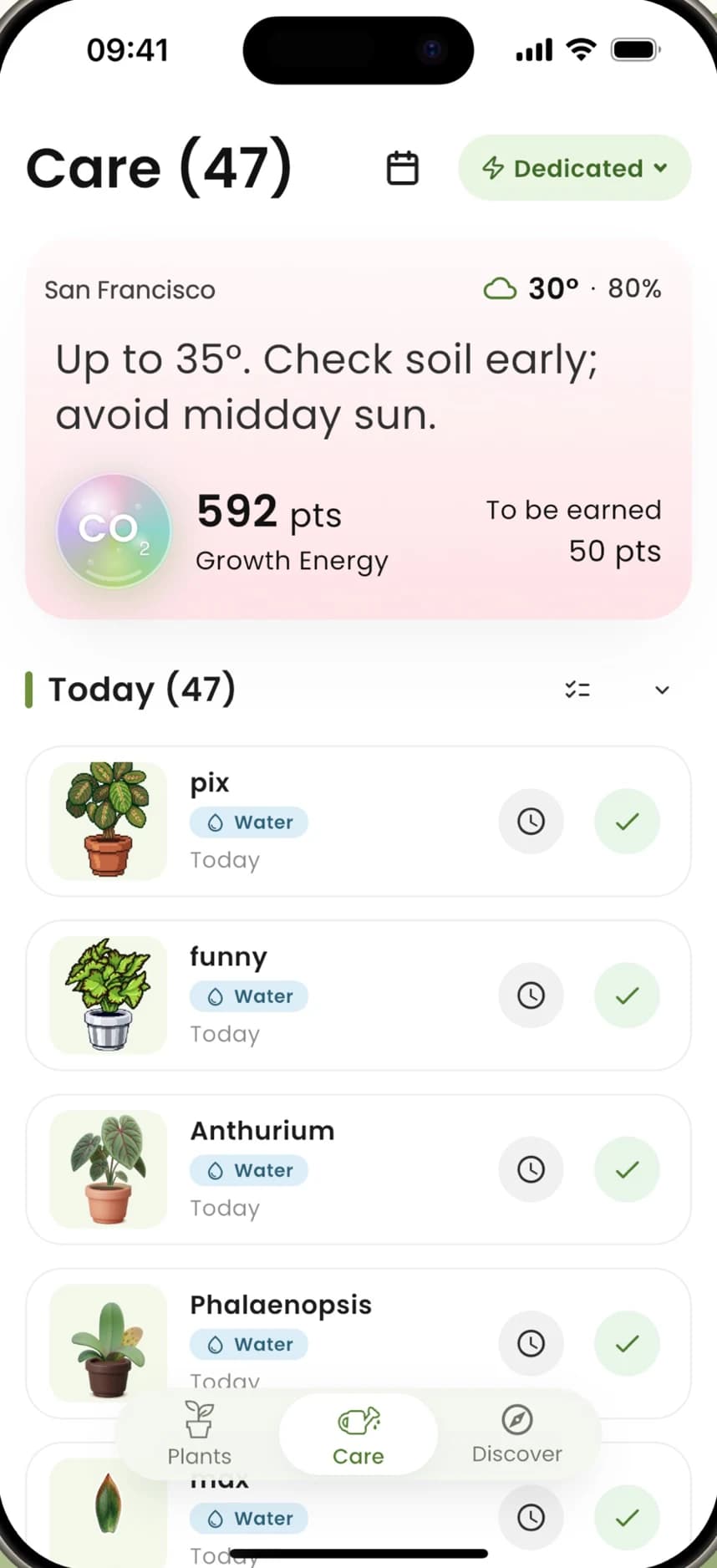
In Plantalk AI, add your pothos with photo identification to get its ideal light and temperature ranges and a care schedule. Send the Plantie Assistant a photo of yellow leaves or a spot for step-by-step answers. The Plantiemoji sensor, sold separately, adds live light, temperature, humidity and soil moisture readings to the plant's Environment view. The app's answers are guidance, so for serious pest or disease problems, also ask a local nursery or plant clinic.
Common Questions
Can Pothos Live in Low Light?
Yes. It survives long periods in low light and tolerates about 540 lux (50 foot-candles)23. New leaves will be smaller and variegated types fade, so solid green 'Jade' suits dim spots better23.
Why Is My Pothos Losing Its Variegation?
Too little light is the usual cause123. Variegated pothos needs about 1,600 lux (150 foot-candles) or more to keep its color3. Move it nearer a bright window, out of direct sun, and watch the new leaves13.
Is Pothos Toxic to Cats and Dogs?
Yes. The ASPCA lists it as toxic to cats and dogs because it contains insoluble calcium oxalates5. Signs include burning and irritation of the mouth, tongue and lips, excessive drooling, vomiting and trouble swallowing5. If your pet eats some, call your vet; in the US, ASPCA Poison Control is (888) 426-4435, and a fee may apply5.
Does Pothos Clean Indoor Air?
Not in a meaningful way. The idea grew from a 1989 NASA study of plants in small, sealed chambers6. Homes constantly exchange air and gain new pollutants, so even about 11 plants per square meter (1 per square foot) cannot keep up6.
Sources
- How to grow epipremnum, Royal Horticultural Society
- Epipremnum aureum, NC State Extension (North Carolina Extension Gardener Plant Toolbox)
- Cultural Guidelines for Commercial Production of Interiorscape Epipremnum (ENH894), UF/IFAS Extension
- Exciting Houseplant Selections for Beginners, Clemson Cooperative Extension Home & Garden Information Center
- Golden Pothos, ASPCA
- Improving Indoor Air Quality with Houseplants, Iowa State University Extension and Outreach
About this guide. Drafted by the Plantalk AI team with AI assistance, checked against the sources listed on each page, and reviewed by an expert before publishing. Reviewed by Bingqing Qi, Wageningen University & Research, on November 9, 2026. Spotted something that needs fixing? Tell us.